 Fort Collins Egress Windows
 Window Well Replacement in Fort Collins
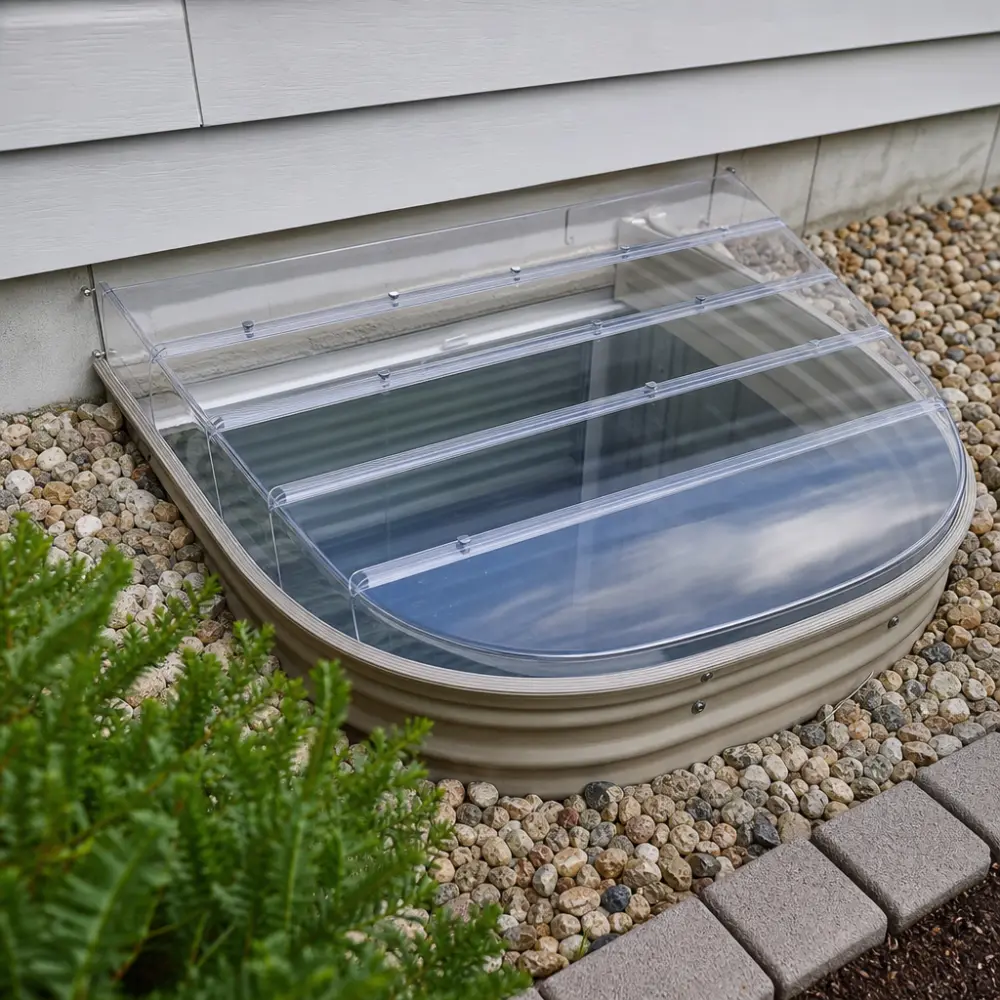
A window well replacement pulls a rusted, collapsed, or undersized well out of an existing opening and sets a code-sized one in its place, over a gravel drainage column, anchored to the foundation, with the ladder the depth requires. In Fort Collins it runs $1,100 to $3,300 installed. The well is the visible part. The column of washed rock underneath it and the grade above it are what decide whether the new well is still dry in ten springs.
What the code requires of a well
The City of Fort Collins Emergency Escape and Rescue Windows guide sets the numbers, and they match IRC R310:
- 36 inches minimum perpendicular to the window, with 9 square feet of ground area
- Ladder or steps once the well is deeper than 44 inches: rungs at least 12 inches wide inside, encroaching no more than 6 inches into the required well space; or steps with an 18 inch maximum rise, 5 inch minimum run, and 12 inch minimum width
- Designed for drainage and connected to the foundation drain if the house has one
- An unobstructed clear path to the public way, sidewalk or street; gates in a fence are permissible, and wells in a series may use a metal grate cover
- Fall protection where a new well sits adjacent to a door or walking surface
Fort Collins has required the 36 inch well with ladder since May 19, 1998. A house permitted before that may have a compliant window sitting in a 24 inch well with no ladder, which is the most common thing we find on a no-ladder call.
Why wells fail here
Three local facts drive nearly all of it.
Expansive clay. The Colorado Geological Survey’s map of the Fort Collins quadrangle names swelling and collapsing soils over the Pierre Shale as one of the two most common natural hazards in the area, and the survey’s hazards page describes bentonite and montmorillonite clays that can expand up to 20 percent by volume when wet and push with up to 30,000 pounds per square foot. A well bolted to a foundation with that clay wetting and drying behind it gets worked loose, bowed, or shoved. The heaving well page covers the symptoms.
No drainage column. The clay percolates poorly. A well set on native soil, or on a token inch of gravel, becomes a bucket every spring. Standing water rusts corrugated steel at the soil line and puts hydrostatic pressure on the window seal. The flooding well page explains the check.
Landscaping against the house. CSU Extension’s guidance for homes on expansive clays is to limit landscaping along the foundation to non-irrigated mulch and xeric plants, avoid trees next to the foundation, and direct roof drainage away. An irrigated flower bed wrapped around a window well does the opposite of all three.
What a replacement includes
- Pull the old well and dig below it. The excavation goes below the old well base to make room for a real gravel column.
- Build the drainage. Washed rock with filter fabric, tied into the footing drain where the house has one. Where it does not, a deep gravel dry well or, on a lot with nowhere for water to go, a pumped outlet quoted on site.
- Set and anchor the new well. Anchored to the foundation wall, not just to the dirt, sized to 36 inches out and 9 square feet.
- Ladder or steps where the depth passes 44 inches, anchored, within the encroachment limit.
- Backfill and grade. Compacted backfill and a finished grade that falls away from the house, with downspouts redirected if one discharges near the well.
- Cover. Strongly recommended given Fort Collins’ 55.8 inch average snowfall; see covers and drainage.
Pricing
| Scope | Typical range |
|---|---|
| Galvanized steel well, under 44 inches, existing drainage sound | $1,100 to $1,800 |
| Galvanized steel well, over 44 inches with ladder, new gravel column | $1,600 to $2,600 |
| Composite terraced well with integrated steps | $2,200 to $3,300 |
| Liner inside a well that still holds its shape | $450 to $950 |
| Drainage rebuild only, well stays | $350 to $1,100 |
| Fitted cover | $175 to $650 |
Every line matches the pricing page, and the well cost calculator combines them for your situation. These ranges are adjusted upward from the same work in the upper Midwest because Colorado labor runs higher and the drainage work here is not a shortcut you can take.
If the house is a rental
The City of Fort Collins Landlord-Tenant Handbook adds two rules for rented homes. Window wells within 3 feet of a driveway or sidewalk must be protected with guardrails or grate covers, and the escape opening must meet the code in effect when the house was built or provide at least 720 square inches of net clear opening, whichever is greater, with a sill no higher than 48 inches. Since January 1, 2025 most long-term rentals in the city register annually and self-certify to the property maintenance code. When we replace a well on a rental beside a drive, the grate goes on the quote as part of the standard, and the city’s guide already allows a metal grate cover on wells in a series.
Season
Well replacement is excavation, so it runs roughly April through mid-November. The NOAA normals for the CSU campus station put the median last spring freeze on May 1 and the first fall freeze on October 6, with 16.10 inches of precipitation and 55.8 inches of snow in an average year. A well that fails in December gets a cover to keep the snow out and a spot early on the spring schedule.
Liner or replacement?
A liner is a real fix when the well still has structure. If the steel passes a screwdriver test at the soil line and the anchors are tight, relining buys years for a fraction of a replacement. If the steel is perforated, the well has bowed, or soil has sloughed in behind it, a liner hides a load-bearing failure and we will say so. The rusted well page has the five-minute test.
When the well work is part of a bigger job
If the opening itself is short of code, the well gets replaced as part of an egress window installation or an enlargement, and the city’s engineer’s letter and permit cover the whole assembly. If the opening is fine and the window is the problem, a basement window replacement at $450 to $1,200 pairs naturally with a new well in the same visit.
Send a photo looking straight down into the well and one from six feet back showing the grade and any downspout. That is usually enough to tell you on the phone whether you are looking at a cover, a rebuild, a liner, or a replacement. The measure is free and the quote is flat, across Fort Collins, Loveland, Windsor, and Timnath.
Frequently Asked Questions
What does a window well replacement cost in Fort Collins?
$1,100 to $3,300 for a code-sized well in an existing opening, including excavation, a new gravel drainage column, anchoring to the foundation, the ladder where the depth requires one, and backfill graded away from the house. Galvanized steel sits at the low end; composite terraced wells and deep wells push toward the top. If the well still holds its shape, a liner at $450 to $950 is the smaller honest fix.
What size does the well have to be?
The city's Emergency Escape and Rescue Windows guide: at least 36 inches perpendicular to the window with a minimum 9 square feet of ground area, a ladder or steps once the well is deeper than 44 inches, drainage connected to the foundation drain if present, and a clear path to the sidewalk or street. A gate in a fence is fine.
Do I need a permit to replace a window well?
If the opening is not changing, the well itself is usually maintenance. If the well is part of a new or enlarged opening, or the sill is being dropped, it rides on that permit and the engineer's letter. We tell you which at the free measure rather than guess.
Why do wells fail so fast on some Fort Collins lots?
Clay. The Colorado Geological Survey maps swelling and collapsing soils over the Pierre Shale under the Fort Collins quadrangle, and describes bentonite clays that expand up to 20 percent by volume when wet. A corrugated well set on that with no gravel column holds water, rusts at the soil line, and gets shoved off the wall as the clay swells and shrinks through the seasons.
Steel or composite?
Galvanized corrugated steel is the value option and, with a real drainage column under it, lasts decades. Composite terraced wells cost more, have no rust clock, and hold back soil better on a tall well. The brands pages compare them honestly; the drainage under either matters more than the flange.